Strengthening Business Models Through Practical Learning and Field Engagement
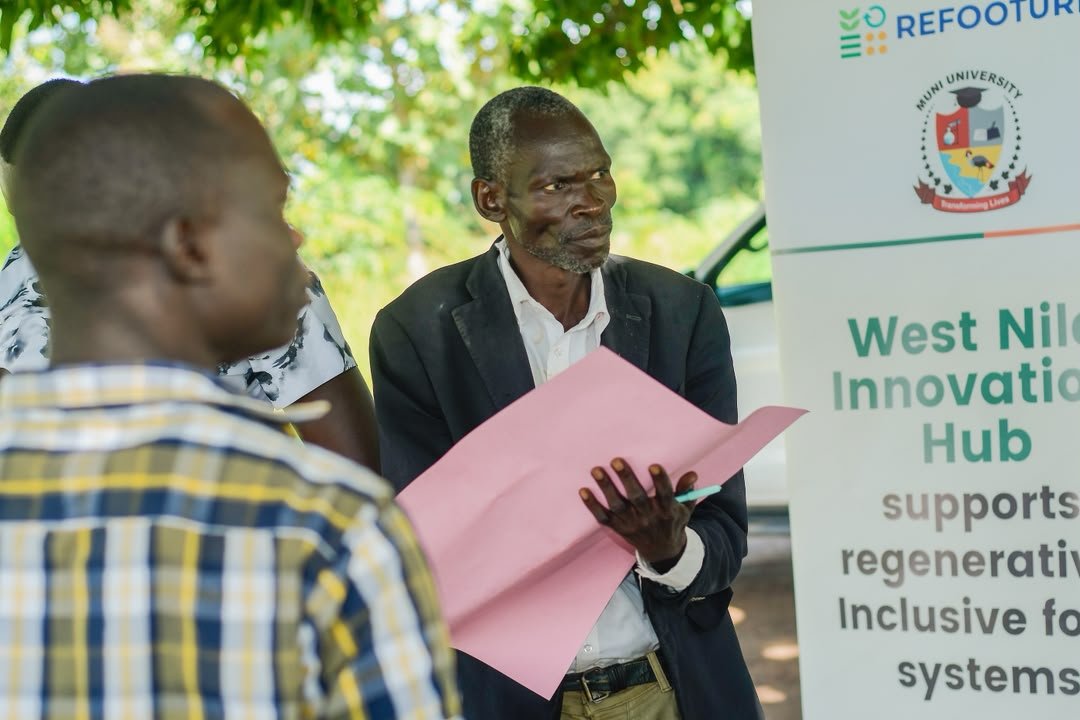
The West Nile Innovation Hub has continued to support incubatees in developing viable, market-responsive, and regenerative enterprises through a practical learning session held at Joke Oria Primary School.
The engagement brought together business model development, customer discovery, and field-based monitoring of minimum viable products (MVPs), enabling incubatees to connect business concepts with the realities of their intended users and operating environments.
The session provided an opportunity for participants to critically examine their business assumptions, assess the relevance of their proposed solutions, and identify areas requiring further refinement as they progress towards developing sustainable enterprises.
Incubatees Refine Their Business Models
The session began with a hands on introduction to the Business Model Canvas (BMC), a strategic tool that helps entrepreneurs map, analyse, and refine the key components of their business models.
Working through the nine building blocks, incubatees examined their customer segments, value propositions, distribution channels, customer relationships, revenue streams, key resources, key activities, key partnerships, and cost structures.
The exercise encouraged participants to move beyond general business ideas and articulate how their ventures intend to create, deliver, and capture value.
Key areas of reflection included defining primary customer segments more precisely, identifying realistic revenue streams to support long-term business sustainability, and exploring strategic partnerships that could strengthen implementation and market access.
Integrating Regenerative Thinking into Value Propositions
Building on the business model discussions, incubatees explored the Regenerative Value Proposition Canvas, applying a broader perspective to how their proposed solutions respond to customer needs while contributing positively to communities and the environment.
Participants examined customer jobs, pains, and gains to better understand the challenges their intended users face and the outcomes they seek. They then considered how their products or services could relieve these challenges, create meaningful benefits, and contribute to the restoration and resilience of the social and ecological systems within which their enterprises operate.
This approach reinforced the importance of developing business solutions that are not only commercially viable but also responsive to community needs and aligned with regenerative development principles.
Customer Interviews Put Business Assumptions to the Test
Following the canvas exercises, incubatees engaged participants at Joke in customer interviews designed to test assumptions about their proposed products and services.
The conversations provided an opportunity to gather direct feedback, deepen understanding of user needs, and assess whether the solutions being developed address real and clearly defined problems.
Through this process, incubatees were encouraged to distinguish between assumptions and evidence, identify previously overlooked customer challenges, and consider adjustments to their value propositions based on the feedback received.
The exercise underscored a fundamental principle of entrepreneurship: effective solutions are developed by understanding customers and testing ideas in real-world settings, rather than relying on assumptions alone.
Field Visits Assess Progress on Minimum Viable Products
Complementing the learning session, the West Nile Innovation Hub team conducted field visits to follow up on the development of incubatees’ minimum viable products (MVPs).
The visits provided an opportunity to observe progress in the field, review developments against established milestones, and identify implementation challenges that may require additional technical guidance or mentorship.
Direct engagement with incubatees and their operating environments also enabled the team to gain practical insights into how the proposed solutions are progressing and where further refinement may be necessary.
This approach strengthens the Hub’s commitment to hands-on incubation, ensuring that support extends beyond classroom-based training to the practical development, testing, and improvement of solutions.
Advancing Market-Responsive and Regenerative Enterprises
The engagement at Joke Oria Primary School highlighted the value of combining structured business model development with customer validation and practical field monitoring.
By applying the Business Model Canvas and Regenerative Value Proposition Canvas, engaging intended users, and reviewing MVP progress, incubatees were supported to make more evidence-informed decisions about their ventures.
The West Nile Innovation Hub will continue to support incubatees through follow-up mentorship, further customer engagement, and progress monitoring as they refine their solutions and advance their enterprise development journeys.
Through these efforts, the Hub seeks to strengthen the development of viable, customer-centred, and regenerative enterprises that respond to local challenges and contribute to sustainable community development.